

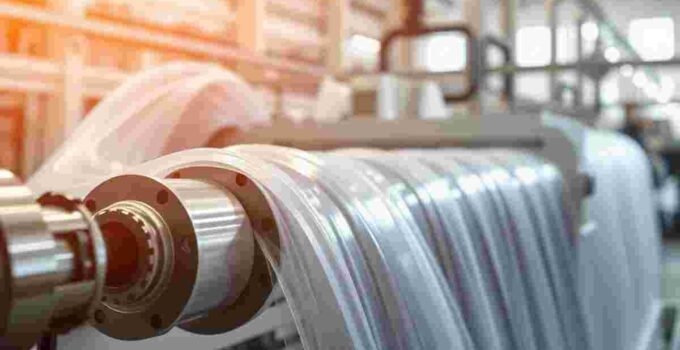
Within the broad landscape of plastics processing technologies, plastic extrusion stands out for its continuous nature – a defining feature that clearly sets it apart from injection molding, which is inherently cyclical. This characteristic makes extrusion the backbone of entire industrial sectors, from water infrastructure manufacturing to the production and automotive applications.The ability to convert a discontinuous material, pellets or powders, into a theoretically endless product with a constant cross-section requires rigorous control over polymer rheology and thermodynamic variables.
It is not simply a matter of melting a material and forcing it through a die, but rather of managing a complex balance of forces, friction and heat transfer that reshapes the resin’s molecular structure before freezing it into a new, stable geometry.
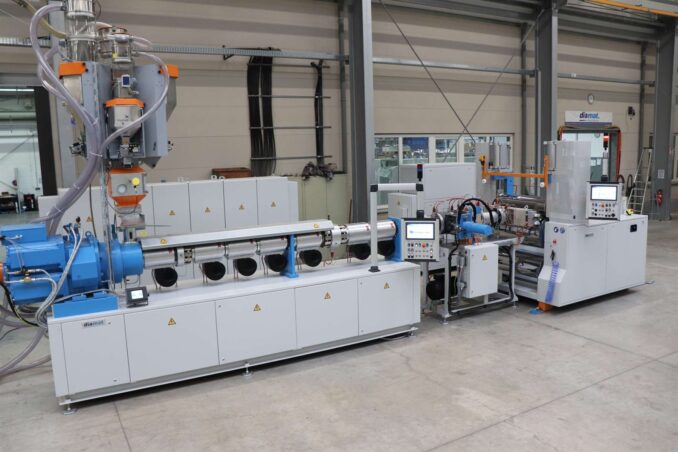
Analyzing this production flow means breaking down the plastic extrusion line into its functional modules and understanding how each one contributes to the creation of the final product.
Polymer handling: feeding and gravimetric dosing
Source: esafetysupplies.com
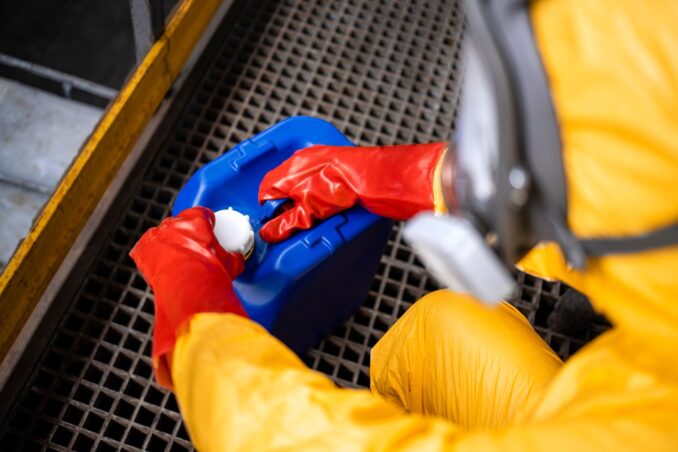
The quality of an extruded profile is determined even before the polymer enters the melting chamber. The feeding stage is, in fact, a critical step. Raw material, typically stored in silos, is conveyed to the extruder via pneumatic systems.
In modern high-performance plants, however, simple gravity feeding is no longer sufficient to guarantee the required consistency. For this reason, loss-in-weight gravimetric feeders are used, sophisticated devices that continuously monitor the mass of material entering the machine and automatically adjust screw speed or forced feeding systems in real time.
At this preliminary stage, material chemistry plays a major role. Engineering polymers such as PET, nylon or polycarbonate are inherently hygroscopic, meaning they absorb atmospheric moisture at the molecular level.
If introduced into the extruder without proper pre-treatment, this trapped water would instantly vaporize at processing temperatures, triggering a phenomenon known as hydrolysis, which breaks polymer chains and drastically reduces the mechanical properties of the finished product, while also causing surface defects.
For this reason, plastic extrusion processes almost always include molecular sieve dryers installed directly above the feed throat, ensuring that the process air’s dew point is low enough to remove any residual moisture.
Plasticization and rheology: screw dynamics
Source: kuhne-mb.de
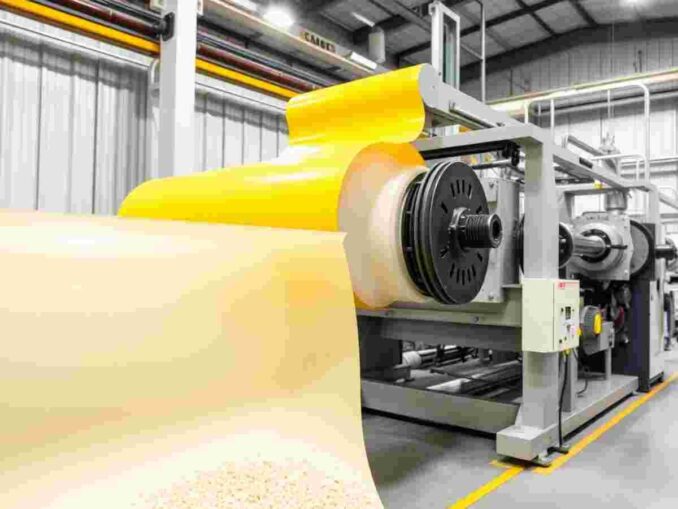
Once inside the barrel, the solid material is conveyed by the plasticizing screw. Contrary to common intuition, the electric heaters wrapped around the barrel provide only a fraction of the heat required for melting, serving mainly during start-up or for thermal stabilization.
The true source of energy is kinetic: viscous friction, generated by the rotating screw as it shears and compresses the material against the barrel walls, produces enough shear heat to melt the polymer.
The screw itself is a masterpiece of fluid mechanics, typically divided into three functional zones that manage the material’s state transition. The feed zone, with its deep channels, transport the solid material. Next comes the compression zone, where the screw core diameter gradually increases, reducing available channel volume.
This mechanical compression forces trapped air backward toward the hopper and performs the work necessary for melting, Finally, the metering zone homogenizes the melt, stabilizing pressure and temperature before discharge.
In complex applications, screws may incorporate dedicated mixing elements – such as Maddock mixers or mixing pins – to ensure uniform dispersion of additives, colorants and mineral fillers throughout the polymer matrix.
Filtration and pressure generation
Source: plastikcity.co.uk
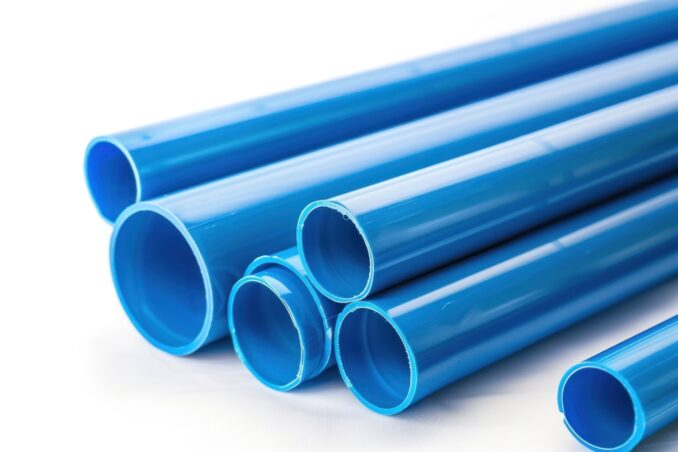
At the end of the screw, the molten polymer encounters the screen pack, supported by a robust perforated steel plate known as the breaker plate. This component serves a dual purpose.
First, it acts as a physical barrier that traps contaminants or partially unmelted particles, which could otherwise compromise the structural integrity of the profile.
Second – and perhaps more importantly from a fluid dynamics standpoint – the screen pack generated the necessary back pressure inside the barrel.
This flow resistance forces the material to fully fill the screw channels in the metering zone, improving mixing efficiency and ensuring that the outgoing flow is laminar and free of pulsation, an essential condition for dimensional stability.
The die: controlling die swell
After leaving the barrel, the material enters the extrusion die, the components that imparts shape. Here, the engineering challenge reaches its peak. Molten polymers behave as non-Newtonian fluids with elastic memory.
When forced through a high-pressure restriction, they undergo molecular compression. Upon exiting the die, they tend to relax and recover volume, a phenomenon known as die swell. Die designers must therefore calculate the die opening dimensions counterintuitively, anticipating and compensating for this expansion.
Moreover, the internal flow channels of the die must perfectly balance flow velocity across the entire cross-section. If, for example, material were to flow faster at the center of a square profile than at the corners, the final products would be distorted. The goal is to achieve a flat velocity at the exit, ensuring that every part of the product is extruded at the same speed.
Calibration and quenching: dimensional stability
Source: facebook.com
Immediately after extrusion, the profile is a hot and amorphous plastic body, unable to support its own weight without deforming. The calibration and cooling phase are responsible for freezing the external dimensions as quickly as possible. For pipes and technical profiles, vacuum calibration is commonly used.
The profile passes through a metal calibrator sleeve immersed in a water tank, where vacuum is applied to the outside of the tube. The resulting pressure differential pulls the still-soft plastic skin against the cold walls of the calibrator, fixing the outer diameter or shape with decimal-level precision.
The product then moves though a series of cooling tanks, spray or immersion systems several meters long, that gradually extract heat from the core of the material. Cooling that is too rapid or even would induce internal residual stresses, which later manifest as warping or brittleness once the product reaches room temperature.
Haul-off and cutting: the end of the line
The component that enables plastic extrusion to operate continuously is the haul-off unit, positioned at the end of the cooling line. Typically equipped with rubber belts or rollers, it must apply constant, vibration-free traction.
There is a direct mathematical relationship between screw rotation speed (which determines output in kg/h) and haul-off speed (in m/min). By adjusting this ratio, the operator defines the wall thickness of the product: increasing haul-off speed at constant output stretches the material, thinning the walls; slowing it down thickens them.
The process concludes with cut-to-length operations. For rigid profiles, guillotine cutters or planetary circular saws are used. These synchronize with the moving profile, perform the cut and return to position, all without ever stopping material flow. Every meter of product that drops into the collection bin is the result of a complex thermodynamic equilibrium, continuously maintained by control systems that monitor pressures and temperatures in real time.